0086-19851820538
carlos@khonorchem.com
 English
 English English
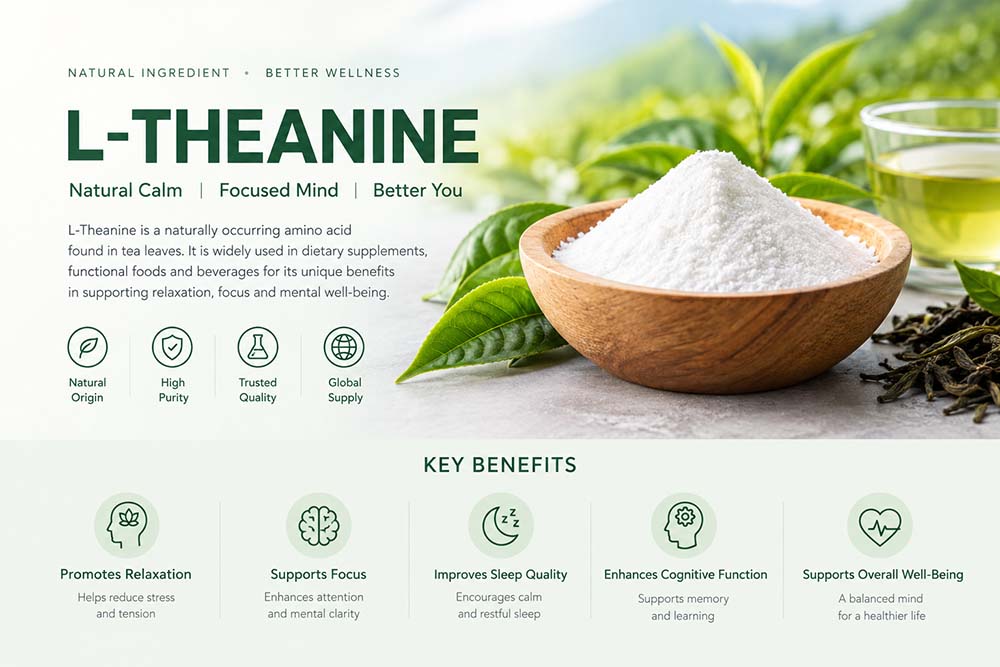
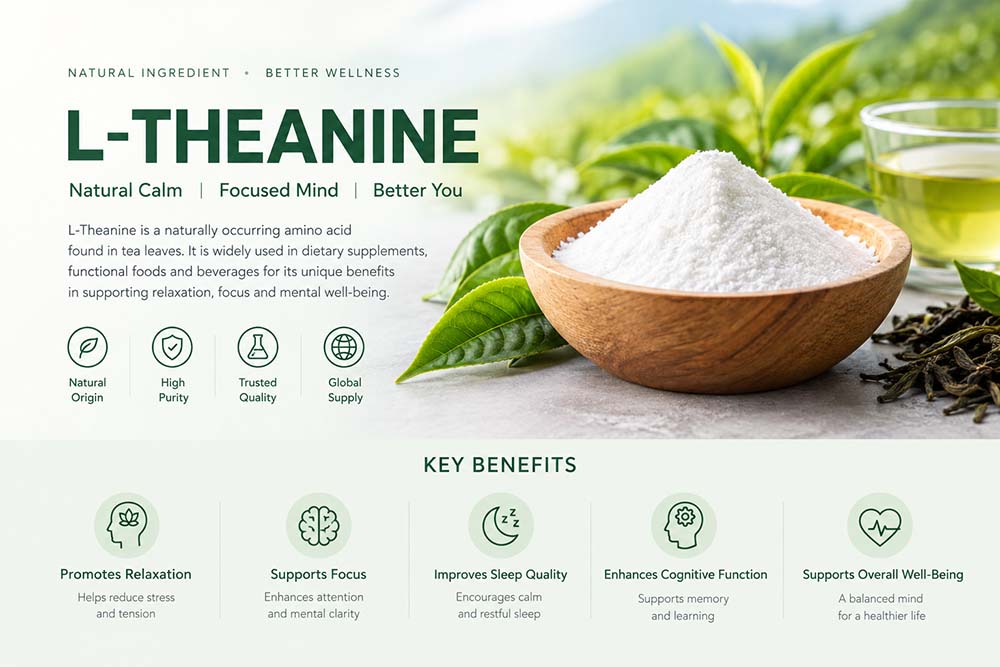
As consumers increasingly explore functional foods and nutritional supplements, ingredient manufacturers are paying greater attention to compounds associated with relaxation, focus, and overall wellness. L-Theanine, a naturally occurring non-protein amino acid found in tea leaves, has become an ingredient of interest in nutritional research and product development.
Known for its distinctive biochemical properties, L-Theanine has been investigated for its potential effects on relaxation, attention, perceived stress, and sleep-related outcomes. It is also used in the development of dietary supplements, functional beverages, and other nutritional formulations.
For food manufacturers and supplement brands, understanding the properties, potential applications, and formulation requirements of L-Theanine is essential when evaluating its suitability for a new product.
In this article, we explore how L-Theanine works, where it is used, what formulators should consider, and how ingredient quality influences commercial applications.
L-Theanine is an amino acid derivative found primarily in the leaves of Camellia sinensis, the plant used to produce green tea, black tea, and other traditional teas.
Unlike standard protein-building amino acids, L-Theanine is not directly incorporated into proteins. Its chemical structure and biological activity have attracted scientific interest, particularly in research involving the nervous system and cognitive processes.
The compound is commonly evaluated for nutritional products designed around relaxation and attention. It is also studied in combination with caffeine, which is naturally present in tea and commonly used in energy and focus products.
Key chemical information:
Product Name: L-Theanine
CAS Number: 3081-61-6
Molecular Formula: C7H14N2O3
Molecular Weight: Approximately 174.20 g/mol
Appearance: Typically a white crystalline powder for commercial ingredient applications
Commercial L-Theanine may be produced through different manufacturing methods. Buyers should confirm the actual source, production process, purity, and applicable documentation with their suppliers.
Research into L-Theanine has focused on its interaction with several biochemical pathways associated with the central nervous system.
Experimental research suggests that L-Theanine may influence glutamate-related signaling and other neurotransmitter-associated processes. Glutamate is an important excitatory neurotransmitter involved in learning, memory, and communication between nerve cells.
The precise mechanisms through which L-Theanine may influence these pathways in humans are not fully established. Its biological effects should therefore be evaluated in the context of the available evidence rather than assumed from its chemical structure alone.
L-Theanine is frequently investigated for its potential relationship with relaxation and perceived stress.
Some human studies have examined subjective stress ratings and physiological responses following L-Theanine intake. However, findings vary by study design, dosage, population, and measurement method.
This research has made L-Theanine an ingredient of interest for relaxation-oriented nutritional products, but it should not be presented as a proven treatment for anxiety or stress-related disorders.
Another area of research concerns attention and cognitive performance, particularly when L-Theanine is combined with caffeine.
Some studies have reported improvements in selected attention-related measures with specific combinations. Nevertheless, results are not uniform, and the effects of a combination product cannot automatically be attributed to L-Theanine alone.
For product developers, this distinction is important when designing formulations and evaluating the evidence needed to support marketing claims.
L-Theanine is used in the development of dietary supplements intended for relaxation, attention, and general wellness.
Supplement manufacturers may incorporate it into capsules, tablets, powders, or other dosage forms, depending on ingredient specifications and formulation requirements.
The suitability of L-Theanine for a particular supplement depends on the target market, permitted ingredients, intended use, and applicable regulatory requirements.
Functional beverages represent another area of interest for L-Theanine ingredient development.
Potential product concepts include tea-based beverages, powdered drink mixes, and other formulations positioned around relaxation or focused attention.
Formulators should evaluate solubility, taste, stability, processing conditions, and compatibility with other ingredients before commercial production.
The final formulation must also meet the relevant food safety and labeling requirements in the destination market.
L-Theanine is often considered for products that combine ingredients associated with attention and alertness.
One example is the combination of L-Theanine and caffeine. Researchers have investigated whether these ingredients may influence selected cognitive performance measures when used together.
The results depend on the formulation and study conditions. Manufacturers should avoid assuming that every ratio or dosage produces the same effects.
L-Theanine is also explored in formulations intended to support relaxation and everyday wellness.
Potential formats include standalone supplements and multi-ingredient blends. Product developers should assess ingredient compatibility, stability, dosage, and substantiation requirements before making claims.
L-Theanine remains a subject of research involving neurochemical pathways, stress-related responses, and cognitive performance.
Research applications require clearly defined material specifications and suitable analytical documentation to ensure that the ingredient meets the requirements of the study.
The combination of L-Theanine and caffeine has attracted attention in the functional nutrition sector.
Caffeine is widely used in beverages and supplements designed around alertness. L-Theanine is studied for its potential effects on relaxation and attention-related outcomes.
Researchers have investigated whether combining these ingredients may affect certain aspects of attention and task performance. Some studies have reported promising findings, but outcomes vary, and further research is needed to establish the consistency and practical significance of these effects.
When developing an L-Theanine and caffeine formulation, manufacturers should consider:
The amount of each ingredient per serving.
The intended consumer group and product positioning.
Ingredient stability and compatibility.
Taste and sensory characteristics.
Applicable safety and labeling requirements.
Scientific support for any performance-related claims.
A combination should be evaluated as a finished formulation rather than assuming that evidence for one ingredient establishes the efficacy of the entire product.
For ingredient buyers, product quality is an important factor in manufacturing consistency and regulatory compliance.
The assay indicates the amount of L-Theanine in the material according to the specified analytical method. High-purity grades are commonly marketed at 98% or higher, although actual specifications must be confirmed with the manufacturer.
Buyers should verify the chemical identity and clarify whether the product is derived from tea, produced through fermentation, or manufactured through another process.
The source and process may influence documentation requirements and suitability for particular customer applications.
Appropriate quality controls should address relevant impurities and other parameters according to the manufacturing process, intended grade, and applicable requirements.
Appearance, moisture content, particle size, and other physical characteristics may affect handling and formulation performance.
Before placing a commercial order, buyers should request and review relevant documents, including:
Technical Data Sheet (TDS).
Batch-specific Certificate of Analysis (COA).
Safety Data Sheet (SDS).
Applicable quality certificates and supporting regulatory documents.
The exact documentation available will depend on the manufacturer and the product grade.
The regulatory status of L-Theanine varies by market, product category, and intended use.
A material that is acceptable for one application or jurisdiction may not automatically be authorized for another. Manufacturers and distributors should verify ingredient eligibility, permitted uses, dosage restrictions where applicable, and labeling requirements before commercializing a finished product.
Safety evaluation should consider the specific ingredient, proposed exposure, target population, other ingredients in the formulation, and available evidence.
Claims related to relaxation, sleep, stress, or cognitive performance should be reviewed against the rules governing food and supplement advertising in the target market.
L-Theanine should not be promoted as a substitute for medical treatment or as a guaranteed solution for sleep or mental health conditions.
L-Theanine continues to attract interest from ingredient suppliers, supplement brands, and functional food developers because it can be incorporated into several product formats.
Potential development directions include:
Relaxation-oriented nutritional formulations.
Functional beverage concepts.
Products combining L-Theanine with caffeine.
Multi-ingredient formulations targeting attention and general wellness.
Research into the relationship between L-Theanine intake and selected physiological outcomes.
Commercial opportunities will depend on consumer demand, scientific substantiation, ingredient quality, pricing, and regulatory requirements.
For suppliers, maintaining consistent specifications and providing reliable technical documentation can help support long-term cooperation with manufacturers and distributors.
L-Theanine is an established subject of nutritional and biochemical research, with potential applications in dietary supplements, functional foods, beverages, and specialized nutritional formulations.
Its relationship with relaxation and attention has encouraged continued scientific investigation. However, the evidence varies across different outcomes, and claims should be based on appropriate research and applicable regulations.
For manufacturers and ingredient buyers, selecting a suitable L-Theanine source requires careful evaluation of chemical identity, purity, production method, documentation, and supply reliability.
Jiangsu Khonor Chemicals Co.,Limited supports international customers seeking chemical and nutritional ingredient sourcing solutions. Contact our team to discuss L-Theanine specifications, documentation, packaging, and commercial supply options.
L-Theanine is used in dietary supplements, functional foods, and beverage formulations. It is commonly investigated for relaxation, attention, and sleep-related outcomes.
Yes. L-Theanine occurs naturally in tea leaves. Commercial products may be manufactured using different production methods, so the source should be verified with the supplier.
L-Theanine and caffeine are combined in some nutritional products. Research has examined selected attention-related outcomes, but results depend on the formulation and study conditions.
High-purity L-Theanine is commonly marketed at 98% or higher. Actual assay and impurity specifications should be confirmed against the manufacturer's approved specification and batch COA.
Buyers should check chemical identity, purity, production source, relevant impurities, physical properties, quality documentation, regulatory suitability, and supply conditions.
Businesses should evaluate suppliers based on verified product specifications, documentation, production capability, pricing, and export experience. Khonor Chemicals can discuss supply requirements subject to product availability and supplier confirmation.
 COA - L-Theanine - 260920T.pdf
Subscribe your E-mail for our
Newsletter & Business Tips
 0086-19851820538
 carlos@khonorchem.com
 Rm 1902 Easey Comm Bldg, 253-261, Hennessy RD Wanchai HK
Back to top
 English
 Spain
 ruso
 Portuguese
 italiano
 Arabic
 French
 Korean
 German
 Turkish
 Vietnamese
 Indonesian
 Dutch
 Polish
 Far
 Thai