0086-19851820538
carlos@khonorchem.com
 English
 English English
JIANGSU KHONOR CHEMI -CALS CO.. LIMITED
Type :Nutrient
E No :
CAS N:3081-61-6
Qty in 20' FCL:10
Packaging :25kg cartons
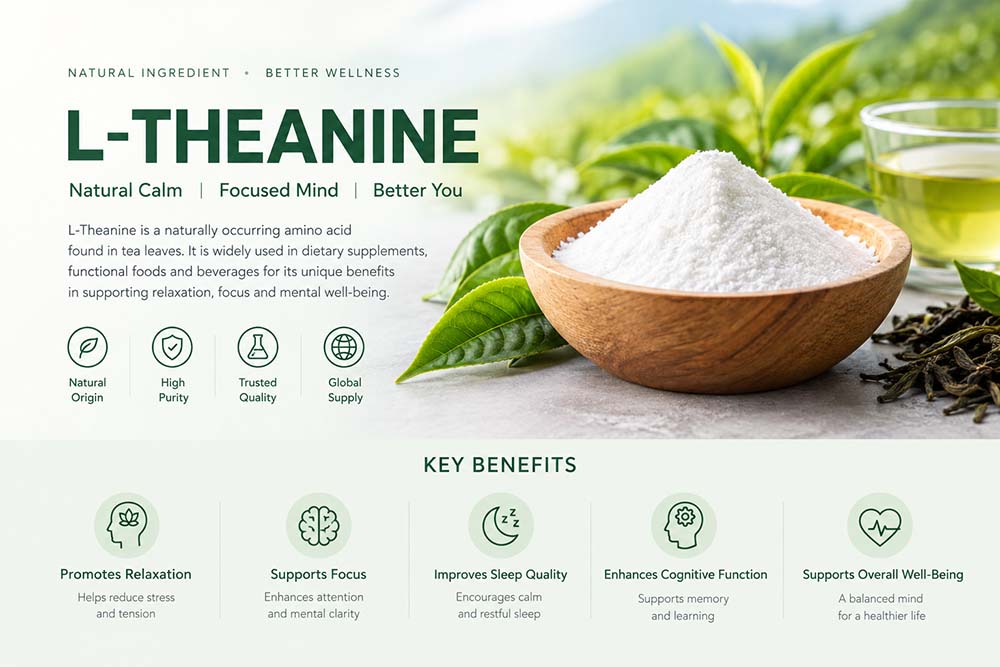
L-Theanine is a naturally occurring non-protein amino acid found primarily in tea leaves, particularly those of Camellia sinensis. It is widely researched for its interaction with the nervous system and its potential applications in relaxation, attention, and cognitive wellness formulations.
As a specialized nutritional ingredient, L-Theanine is used in dietary supplements, functional foods, beverages, and other product formulations, subject to applicable regulations and intended-use requirements.
L-Theanine has attracted interest from nutritional ingredient manufacturers because of its distinctive chemical structure and its relationship with several neurotransmitter-related pathways. It is frequently incorporated into formulations designed for relaxation and focus, although the effects of a finished product depend on dosage, formulation, and individual factors.
Khonor Chemicals supports international customers seeking reliable supplies of specialty chemicals and nutritional ingredients, with a focus on competitive pricing, quality documentation, responsive service, and export coordination.
Product Name: L-Theanine
Chemical Name: L-Theanine
CAS Number: 3081-61-6
Molecular Formula: C7H14N2O3
Molecular Weight: 174.20 g/mol
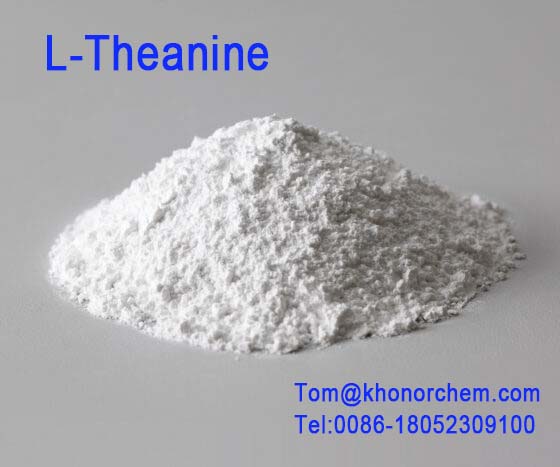
Appearance: White crystalline powder
Product Category: Amino Acid Derivative / Nutritional Ingredient
Typical Assay: 98.0% minimum, subject to the confirmed product specification
Grade: Food Grade / Nutritional Supplement Grade, subject to supplier confirmation
Naturally occurring amino acid found in tea.
Widely studied for relaxation and attention-related applications.
Suitable for evaluation in dietary supplement and functional food formulations.
Available in powder form for ingredient manufacturing.
Can be supplied according to agreed specifications and packaging requirements.
L-Theanine is a non-protein amino acid that occurs naturally in tea leaves. Unlike the standard amino acids used directly to build proteins, L-Theanine has a distinctive structure that contributes to its unique biochemical properties.
It has been investigated for its effects on relaxation, perceived stress, attention, and sleep-related outcomes. Researchers have also studied its interactions with neurotransmitter systems and its potential relationship with the physiological effects of tea consumption.
L-Theanine is often selected for formulations intended to support a calm and focused state. It is also combined with other nutritional ingredients, including caffeine, in certain products designed for attention and alertness.
The scientific evidence varies by outcome, dose, and formulation. L-Theanine should not be described as a treatment for anxiety, insomnia, or other medical conditions.
L-Theanine has been studied for its potential influence on neurotransmitter-related processes in the central nervous system.
Experimental research suggests that it may interact with pathways associated with glutamate signaling and other neurochemical systems. However, the precise mechanisms responsible for its effects in humans are not fully established.
These interactions are among the reasons L-Theanine continues to attract interest in nutritional and cognitive wellness research.
L-Theanine is commonly investigated for its potential to promote relaxation without necessarily producing the pronounced sedation associated with some other substances.
Some human studies have examined subjective stress, physiological stress responses, and relaxation following L-Theanine intake. Results vary across studies, and the evidence does not establish a consistent effect for every individual or application.
For ingredient developers, L-Theanine is therefore a relevant candidate for relaxation-oriented nutritional formulations, subject to appropriate substantiation and regulatory review.
L-Theanine has also been studied in relation to attention and cognitive performance.
Research has explored L-Theanine alone and in combination with caffeine. Some studies suggest that specific combinations may influence selected measures of attention or task performance, but results depend on the study design, dose, and population.
The effects of L-Theanine alone should be distinguished from those of combination products. Claims about enhanced concentration or cognitive performance should be supported by evidence appropriate to the specific finished formulation.
L-Theanine has attracted interest in research examining relaxation and subjective sleep quality.
Some studies have reported improvements in selected self-reported sleep outcomes, but evidence remains limited and does not establish L-Theanine as a treatment for insomnia or other sleep disorders.
Its potential application in evening relaxation formulations should be evaluated in accordance with the intended use, available evidence, and applicable regulations.
L-Theanine is used in the development of nutritional supplements targeting relaxation, focus, and general wellness. Product positioning and permissible claims vary between markets.
Depending on the product grade, formulation compatibility, and local regulations, L-Theanine may be evaluated for use in functional beverages and other food products.
L-Theanine is frequently considered for formulations designed around calm attention and alertness. Some products combine it with caffeine, but formulation performance and claims require appropriate evaluation.
L-Theanine is used in the development of products intended to support relaxation and manage everyday stress. Such positioning must comply with the relevant labeling and advertising rules in the destination market.
L-Theanine may also be used in formulation development and scientific research investigating its physicochemical properties and potential physiological effects.
The following is a preliminary specification framework for a typical high-purity L-Theanine powder. Final acceptance criteria must be confirmed with the manufacturer.
Appearance: White crystalline powder
Identification: Conforms to the applicable identification test
Assay: ≥98.0%, subject to confirmation
Loss on Drying: To be confirmed according to the manufacturer's specification
Specific Rotation: To be confirmed according to the applicable product standard and test conditions
pH: To be specified with the test solution concentration and method
Residue on Ignition: To be confirmed
Heavy Metals: Must comply with the applicable specification
Lead (Pb): According to the approved product specification
Arsenic (As): According to the approved product specification
Cadmium (Cd): According to the approved product specification
Mercury (Hg): According to the approved product specification
Microbiological Limits: According to the applicable grade and destination-market requirements
For commercial transactions, the actual product specification and batch-specific Certificate of Analysis (COA) take precedence over this preliminary description.
Consistent product quality is essential for nutritional ingredient manufacturing.
Before purchasing L-Theanine, customers should evaluate the following:
Chemical identity and assay.
Relevant impurity and residual-solvent controls, where applicable.
Moisture content and physical appearance.
Microbiological quality for the intended food or supplement application.
Batch consistency and traceability.
Compliance with the relevant destination-market requirements.
Available documentation may include a Technical Data Sheet (TDS), Safety Data Sheet (SDS), Certificate of Analysis (COA), and applicable quality or certification documents, subject to supplier availability.
L-Theanine can be supplied in packaging formats agreed between the supplier and customer.
Packaging options should provide appropriate protection against moisture, contamination, and handling damage during storage and transportation.
Customers can contact Khonor Chemicals to discuss available package sizes, minimum order quantities, sample arrangements, lead times, and bulk supply requirements.
Customized packaging and labeling may be discussed according to order requirements and applicable regulations.
Store L-Theanine in a tightly sealed container in a cool, dry, and well-ventilated place.
Protect the product from moisture, direct sunlight, and contamination. Close the container securely after opening and use appropriate handling practices to prevent unnecessary dust generation.
Follow the manufacturer's recommended storage conditions and shelf life. Refer to the applicable SDS for detailed handling and safety information.
Jiangsu Khonor Chemicals Co.,Limited supplies a range of chemicals, food ingredients, feed additives, water treatment chemicals, fertilizers, and specialty ingredients to international customers.
Our supply approach focuses on:
Competitive Pricing: We work with qualified supply partners to develop commercially competitive sourcing solutions.
Quality Coordination: We coordinate product specifications and quality documentation according to customer requirements.
Flexible Sourcing: Our supplier network covers multiple chemical and nutritional ingredient categories.
Export Support: We assist with export documentation, packaging coordination, and shipment arrangements.
Responsive Service: We aim to provide timely communication and practical support throughout the inquiry and ordering process.
Long-Term Cooperation: We seek to build stable supplier relationships and provide solutions aligned with customers' product requirements and target markets.
Product availability, specifications, certification documents, and delivery schedules are subject to confirmation.
Q1: What is L-Theanine used for?
L-Theanine is used in dietary supplements, functional foods, beverages, and nutritional ingredient formulations. It is commonly researched for relaxation, attention, and sleep-related outcomes.
Q2: What is the CAS number of L-Theanine?
The CAS number commonly associated with L-Theanine is 3081-61-6.
Q3: What is the molecular formula of L-Theanine?
The molecular formula is C7H14N2O3, and the molecular weight is approximately 174.20 g/mol.
Q4: Is L-Theanine naturally occurring?
Yes. L-Theanine occurs naturally in tea leaves. Commercial products may be manufactured using different production methods, so the source and manufacturing process should be confirmed with the supplier.
Q5: Is L-Theanine suitable for dietary supplements?
It may be suitable for certain dietary supplement applications, depending on the product grade and the applicable regulations in the destination market. Buyers should verify regulatory status and permitted uses before commercialization.
Q6: What purity levels are available?
High-purity L-Theanine products are commonly marketed at 98% or higher. Actual assay, impurity limits, and available grades must be confirmed against the manufacturer's current specification.
Q7: What documents can be provided?
Depending on supplier arrangements, available documents may include a TDS, SDS, batch COA, and applicable quality certificates.
Q8: How should L-Theanine be stored?
Store in a tightly sealed container in a cool, dry place, protected from moisture and contamination. Follow the manufacturer's instructions for shelf life and storage.
Looking for a reliable L-Theanine supplier for your nutritional ingredient business?
Contact Jiangsu Khonor Chemicals Co.,Limited to discuss product specifications, documentation, packaging, samples, and bulk supply options.
Website: www.khonorchem.com
Contact our sales team for current availability and a quotation tailored to your requirements.
Subscribe your E-mail for our
Newsletter & Business Tips
 0086-19851820538
 carlos@khonorchem.com
 Rm 1902 Easey Comm Bldg, 253-261, Hennessy RD Wanchai HK
Back to top
 English
 Spain
 ruso
 Portuguese
 italiano
 Arabic
 French
 Korean
 German
 Turkish
 Vietnamese
 Indonesian
 Dutch
 Polish
 Far
 Thai