0086-19851820538
carlos@khonorchem.com
 English
 English English
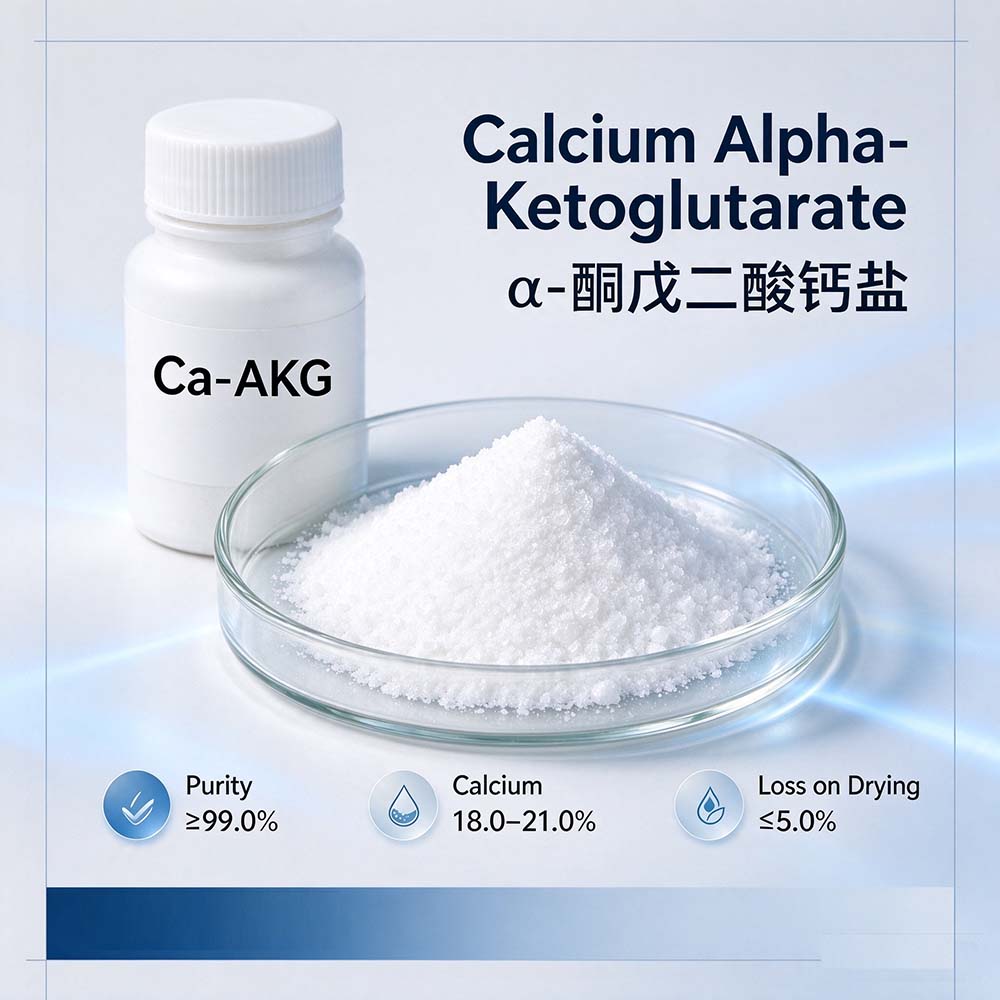
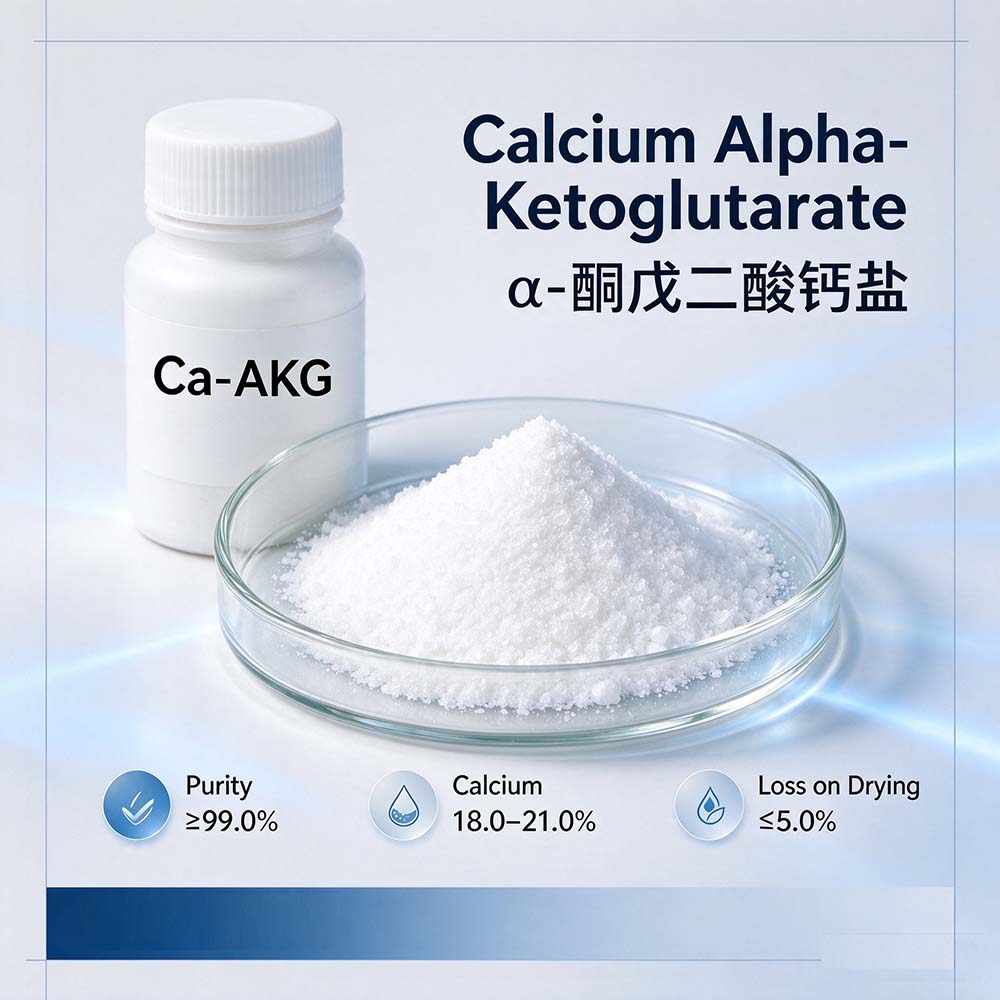
Calcium Alpha-Ketoglutarate, commonly known as AKG-Ca or Calcium AKG, is a calcium salt of alpha-ketoglutaric acid, a naturally occurring compound involved in fundamental metabolic processes. Alpha-ketoglutarate plays an important role in the tricarboxylic acid (TCA) cycle, also known as the citric acid cycle or Krebs cycle, which helps cells convert nutrients into usable energy.
In recent years, alpha-ketoglutarate has attracted growing scientific interest because of its involvement in cellular metabolism, amino acid regulation, and biological processes associated with aging. These functions have encouraged researchers to investigate its potential applications in nutritional science and healthy-aging research.
Calcium Alpha-Ketoglutarate combines alpha-ketoglutarate with calcium, an essential mineral that contributes to normal bone structure, muscle function, and nerve signaling. However, the biological functions of alpha-ketoglutarate do not automatically establish the clinical benefits of supplementing with AKG-Ca.
This article explores what Calcium Alpha-Ketoglutarate is, how it works at the biochemical level, its potential areas of application, and the scientific considerations relevant to its development as a nutritional ingredient.
Calcium Alpha-Ketoglutarate is a calcium salt derived from alpha-ketoglutaric acid, also called 2-oxoglutaric acid. Alpha-ketoglutarate is an intermediate in the TCA cycle and is involved in several interconnected metabolic pathways.
The TCA cycle is central to aerobic energy metabolism. It helps process products derived from carbohydrates, fats, and proteins, supporting the production of energy through cellular respiration.
Beyond energy metabolism, alpha-ketoglutarate participates in amino acid metabolism and serves as a co-substrate for certain enzymes involved in cellular regulation.
The calcium component provides a source of calcium, depending on the exact chemical composition and purity of the product.
Key characteristics of AKG-Ca include:
Chemical category: Organic calcium salt.
Main functional component: Alpha-ketoglutarate.
Mineral component: Calcium.
Scientific relevance: Cellular metabolism, amino acid pathways, and research into aging-related biological processes.
Potential development areas: Specialized nutritional ingredients and biochemical research, subject to product suitability and applicable regulations.
The exact molecular formula, molecular weight, CAS number, and hydration state should be confirmed against the specific AKG-Ca product being supplied, because different chemical forms may have different specifications.
Understanding the mechanism of action of Calcium Alpha-Ketoglutarate begins with the biological functions of alpha-ketoglutarate.
One of the most important functions of alpha-ketoglutarate is its participation in the TCA cycle.
During cellular respiration, nutrients are metabolized through interconnected biochemical reactions. The TCA cycle generates reduced coenzymes, including NADH and FADH2, which support ATP production through oxidative phosphorylation.
Alpha-ketoglutarate is converted into succinyl-CoA through an enzyme-catalyzed reaction. This step contributes to the continued operation of the TCA cycle and the production of metabolic intermediates.
Because alpha-ketoglutarate is part of this pathway, researchers study its role in cellular energy metabolism and metabolic regulation.
However, being a TCA-cycle intermediate does not necessarily mean that oral AKG-Ca supplementation increases energy production, improves exercise performance, or reduces fatigue in healthy people. These outcomes require direct clinical evidence.
Alpha-ketoglutarate is closely connected to amino acid metabolism, particularly through its relationship with glutamate.
In transamination reactions, amino groups can be transferred between amino acids and alpha-keto acids. Alpha-ketoglutarate can accept an amino group to form glutamate, linking carbon metabolism with nitrogen metabolism.
This relationship is important because the body must coordinate the metabolism of amino acids with energy production and the synthesis of other biological molecules.
The interaction between alpha-ketoglutarate and amino acid pathways makes it a relevant subject in metabolic research and specialized ingredient development.
Alpha-ketoglutarate serves as a co-substrate for several alpha-ketoglutarate-dependent dioxygenases.
These enzymes participate in diverse biochemical processes, including certain reactions involved in collagen modification, oxygen sensing, and the regulation of gene expression through epigenetic mechanisms.
This broad involvement has made alpha-ketoglutarate an important molecule in studies of cellular adaptation, tissue biology, and aging-related mechanisms.
Nevertheless, these enzyme-level functions should not be interpreted as proof that AKG-Ca supplementation produces measurable improvements in human health or longevity.
Scientific interest in AKG-Ca is based on the known biological functions of alpha-ketoglutarate and calcium. The strength of evidence varies considerably between established physiological functions and proposed supplementation benefits.
Healthy aging is one of the most discussed areas of alpha-ketoglutarate research.
As organisms age, changes can occur in cellular metabolism, mitochondrial function, inflammatory signaling, and the regulation of gene expression. Because alpha-ketoglutarate participates in several metabolic and enzyme-dependent pathways, researchers are investigating whether changes in its availability or metabolism may be associated with aging-related processes.
Preclinical research has examined alpha-ketoglutarate in relation to lifespan, metabolic health, and physiological changes associated with aging. Some animal studies have reported promising findings, but animal results cannot be directly translated into human benefits.
It is therefore more accurate to describe AKG-Ca as an ingredient of scientific interest in healthy-aging research rather than as a proven anti-aging treatment.
Calcium is essential for maintaining normal bones and teeth. It also contributes to muscle contraction, nerve transmission, and other physiological functions.
Because AKG-Ca contains calcium, its potential contribution to calcium intake depends on the amount of elemental calcium supplied per serving.
The alpha-ketoglutarate component has also been investigated in research involving bone metabolism and collagen-related biochemical pathways. However, evidence concerning one alpha-ketoglutarate compound or experimental formulation does not necessarily establish that Calcium Alpha-Ketoglutarate improves bone density or prevents osteoporosis.
For nutritional product developers, the calcium content, bioavailability, solubility, and intended formulation should be evaluated before making any bone-health claims.
Alpha-ketoglutarate is a central metabolic intermediate connecting the TCA cycle with amino acid metabolism.
This makes it relevant to research into how cells use nutrients, maintain metabolic balance, and respond to physiological changes.
Researchers are interested in how alpha-ketoglutarate availability interacts with other metabolic substrates and enzyme systems. Such investigations may help improve understanding of cellular metabolism, but they do not establish that AKG-Ca supplementation enhances metabolism in healthy consumers.
Energy metabolism and amino acid utilization are relevant to exercise physiology. Since alpha-ketoglutarate participates in both pathways, it has been studied in the broader context of metabolic and nutritional research.
However, evidence from other AKG salts, multi-ingredient formulations, or specific athletic populations should not be assumed to apply to Calcium Alpha-Ketoglutarate.
At present, claims that AKG-Ca reliably increases muscle strength, improves endurance, accelerates recovery, or reduces fatigue require stronger direct clinical evidence.
From an ingredient-development perspective, AKG-Ca may be considered for specialized nutritional formulations where its chemical identity, calcium content, stability, and regulatory status are appropriate.
Potential development work may include:
Formulation compatibility and stability studies.
Evaluation of powder flow and processing characteristics.
Assessment of calcium content and other nutritional parameters.
Research into alpha-ketoglutarate-related metabolic pathways.
Product development for markets where the ingredient is legally permitted.
The suitability of AKG-Ca for any finished product depends on the intended use, target population, manufacturing quality, and local regulations.
Interest in AKG and longevity has increased as researchers investigate the relationships between cellular metabolism and aging.
Alpha-ketoglutarate is relevant to this field for several reasons.
First, it is a central metabolic intermediate, linking energy production with the metabolism of amino acids and other nutrients.
Second, it acts as a co-substrate for enzymes involved in epigenetic regulation and other cellular processes.
Third, experimental studies have investigated the effects of alpha-ketoglutarate-related interventions on biological changes associated with aging.
These findings provide a scientific rationale for continued investigation. However, several important distinctions must be maintained:
Results from animal studies do not establish efficacy in humans.
Findings involving alpha-ketoglutaric acid or other AKG salts may not apply directly to AKG-Ca.
Changes in laboratory biomarkers do not necessarily translate into longer lifespan or improved healthspan.
The effective dose, safety profile, and long-term effects of a specific AKG-Ca formulation require appropriate evaluation.
For these reasons, Calcium Alpha-Ketoglutarate is best described as a research-relevant nutritional ingredient rather than a proven longevity supplement.
Alpha-ketoglutarate can be supplied in different chemical forms. Understanding these differences is important when selecting ingredients for nutritional and research applications.
Calcium Alpha-Ketoglutarate (AKG-Ca)
AKG-Ca is a calcium salt of alpha-ketoglutarate. Its chemical composition determines its elemental calcium content, hydration state, and other physicochemical properties.
Arginine Alpha-Ketoglutarate (AAKG)
AAKG combines alpha-ketoglutarate with arginine. It is commonly discussed in sports nutrition ingredient development. Its properties and nutritional contribution differ from those of calcium alpha-ketoglutarate.
Alpha-Ketoglutaric Acid
The free-acid form is chemically distinct from its calcium salt. Differences in acid-base properties, formulation behavior, and composition may affect its suitability for particular applications.
These ingredients should not be treated as interchangeable. Product selection should be based on the intended application, verified specifications, available safety data, and relevant clinical evidence.
For manufacturers, distributors, and nutritional ingredient developers, product quality and consistency are essential.
Important evaluation criteria include:
Chemical Identity: Confirm the precise calcium-to-alpha-ketoglutarate ratio, hydration state, molecular formula, and applicable CAS number.
Assay and Purity: Establish appropriate acceptance criteria using validated analytical methods.
Calcium Content: Verify the elemental calcium concentration according to the confirmed chemical form.
Moisture Content: Evaluate water content or loss on drying, especially where storage stability is important.
Impurity Control: Review the limits and analytical methods for relevant impurities and heavy metals.
Physical Properties: Assess appearance, particle size, flow characteristics, and solubility where relevant to the intended application.
Documentation: Request an appropriate technical data sheet (TDS), certificate of analysis (COA), safety data sheet (SDS), and other applicable quality documents.
Regulatory Compliance: Confirm whether the ingredient is permitted for the intended use in the destination market.
These factors help buyers assess product suitability and establish consistent raw-material requirements.
The safety of a nutritional ingredient depends on its identity, purity, dose, intended use, and the characteristics of the target population.
The presence of calcium in AKG-Ca does not automatically establish the safety of every formulation or dosage. Total calcium intake, potential interactions, underlying health conditions, and other ingredients may be relevant to product assessment.
Manufacturers should review the available toxicological and clinical evidence for the exact ingredient and intended exposure.
Regulatory requirements for dietary ingredients vary by country and may differ according to whether the product is marketed as a food ingredient, dietary supplement, conventional food, or research material.
Before commercializing AKG-Ca in a specific market, businesses should verify the applicable ingredient authorization, labeling rules, and permitted health claims.
Calcium Alpha-Ketoglutarate is an organic calcium salt that connects two areas of biochemical interest: alpha-ketoglutarate-related metabolism and calcium nutrition.
Alpha-ketoglutarate plays established roles in the TCA cycle, amino acid metabolism, and several enzyme-dependent cellular processes. These functions have encouraged research into its potential relevance to healthy aging, metabolic regulation, and nutritional ingredient development.
At the same time, the established biochemical functions of alpha-ketoglutarate should be distinguished from the clinical benefits of supplementing with AKG-Ca. More direct human research is needed to establish its effectiveness for specific health outcomes.
For businesses developing nutritional ingredients, product identity, quality specifications, safety documentation, and regulatory suitability remain essential considerations.
Jiangsu Khonor Chemicals Co.,Limited works with customers seeking chemical and nutritional ingredient supply solutions. Contact our team to discuss Calcium Alpha-Ketoglutarate product specifications, technical documentation, packaging options, and commercial availability.
Q1: What does AKG-Ca stand for?
AKG-Ca stands for Calcium Alpha-Ketoglutarate, a calcium salt of alpha-ketoglutaric acid.
Q2: What is the main function of alpha-ketoglutarate?
Alpha-ketoglutarate is an intermediate in the TCA cycle and participates in amino acid metabolism. It also serves as a co-substrate for several enzymes involved in cellular biochemical processes.
Q3: Can AKG-Ca slow down aging?
Research has explored alpha-ketoglutarate-related interventions in aging models. However, current evidence does not establish that AKG-Ca supplementation slows human aging or extends human lifespan.
Q4: Does AKG-Ca support bone health?
AKG-Ca contains calcium, which is essential for normal bone maintenance. Whether a particular AKG-Ca product provides a meaningful benefit for bone health depends on its calcium content, bioavailability, intended use, and supporting evidence.
Q5: Is AKG-Ca the same as AAKG?
No. AKG-Ca is the calcium salt of alpha-ketoglutarate, while AAKG is arginine alpha-ketoglutarate. They differ in chemical composition and should be evaluated separately.
Q6: What should buyers check before purchasing AKG-Ca?
Buyers should verify the chemical form, CAS number, assay, calcium content, moisture specification, impurity limits, quality documentation, and regulatory suitability for their intended application.
Q7: Where can I source Calcium Alpha-Ketoglutarate?
Commercial availability and specifications should be confirmed with a qualified supplier. Khonor Chemicals can discuss sourcing requirements, technical documentation, and supply options subject to product availability.
Subscribe your E-mail for our
Newsletter & Business Tips
 0086-19851820538
 carlos@khonorchem.com
 Rm 1902 Easey Comm Bldg, 253-261, Hennessy RD Wanchai HK
Back to top
 English
 Spain
 ruso
 Portuguese
 italiano
 Arabic
 French
 Korean
 German
 Turkish
 Vietnamese
 Indonesian
 Dutch
 Polish
 Far
 Thai